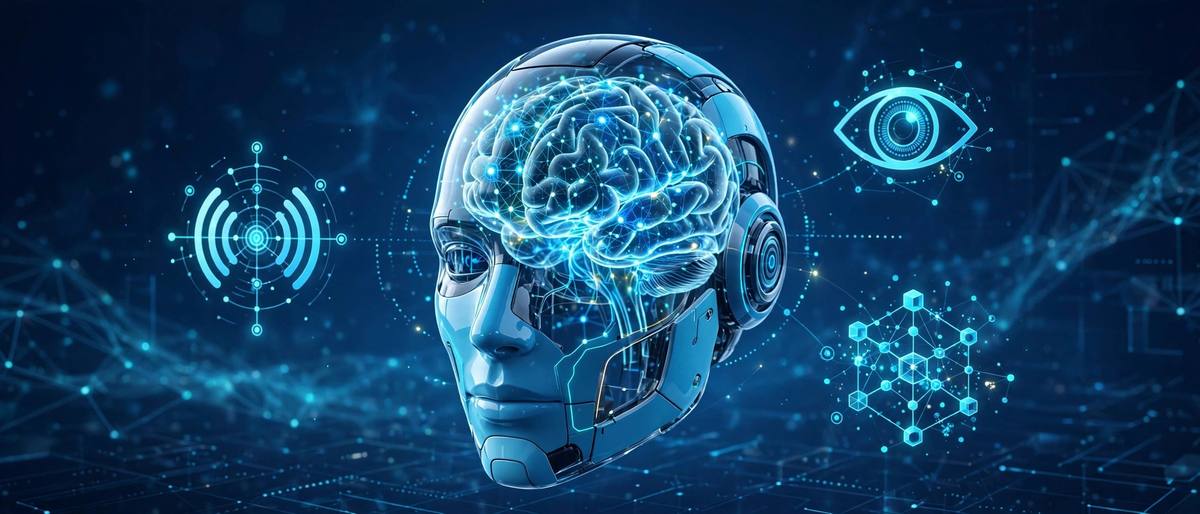
Artificial intelligence is one of those phrases everyone uses and few can define. It appears in headlines about chatbots, in marketing for everything from toothbrushes to tractors, and in debates about the future of work. But what is artificial intelligence, really — beneath the hype?
Simply put, AI is a field of computer science devoted to building systems that perform tasks requiring intelligence when humans do them: understanding language, recognizing images, making predictions, and solving problems. Modern AI does not “think” like a person; it finds patterns in enormous amounts of data and uses those patterns to make remarkably capable guesses.
This guide explains AI in plain English: what the term covers, how the main techniques work, where you already encounter AI daily, and — just as important — what AI cannot do.
- What “Artificial Intelligence” Actually Means
- How Modern AI Works (The Short Version)
- The Main Types of AI You’ll Encounter
- AI in Your Daily Life Already
- What AI Can’t Do (Yet)
- Looking Ahead: Staying Informed
What “Artificial Intelligence” Actually Means
The term dates to 1956, when researchers coined it for a conference on making machines simulate human intelligence. Since then its meaning has stretched: today “AI” covers everything from a spam filter to a system that writes essays. The unifying idea is software that handles tasks we associate with human judgment — classifying, predicting, translating, deciding — without being explicitly programmed with rules for every case.
That last point is the key break from traditional software. A conventional program follows rules its programmers wrote: if this, then that. An AI system instead learns from examples: show it a million labeled photos and it figures out on its own what distinguishes a cat from a dog. The programmer designs the learning process; the data teaches the specifics.
This is why AI discussions keep returning to data. An AI system is only as good as what it learned from — biased, incomplete, or low-quality training data produces biased, unreliable behavior. Understanding that connection demystifies both AI’s impressive feats and its embarrassing failures.
How Modern AI Works (The Short Version)
Most of today’s AI breakthroughs come from machine learning, and specifically from neural networks — mathematical structures loosely inspired by the brain, made of layers of interconnected “neurons” that adjust their connections as they train. During training, the network makes predictions, measures its errors, and tweaks millions or billions of internal parameters to do better next time. Repeat that billions of times over massive datasets and you get systems with startling capabilities.
Deep learning just means neural networks with many layers, which lets them learn hierarchical patterns: early layers detect edges in an image, middle layers detect shapes, later layers recognize objects. The same principle applies to language — models learn that certain word patterns predict others, building up from grammar to facts to reasoning-like behavior.
Crucially, these systems are probabilistic, not certain. When an AI chatbot answers your question, it is generating the most likely good response based on patterns — not retrieving a verified fact from a database. That distinction explains both its fluency and its occasional confident nonsense.
The Main Types of AI You’ll Encounter
Narrow AI — systems designed for one task — is what actually exists today: recommendation engines, voice assistants, fraud detection, translation tools, image recognition. Every AI product you use is narrow AI, however impressive it feels. There is no general-purpose machine intelligence that can do anything a human can.
Generative AI is the category behind the recent excitement: systems that create new content — text, images, code, music — rather than just classifying or predicting. Chatbots, image generators, and writing assistants all belong here. They work by learning the patterns of their training data so thoroughly they can produce novel examples in the same style.
You will also hear “AGI” (artificial general intelligence) in debates about the future — hypothetical human-level intelligence across all domains. It does not exist, experts disagree sharply on if or when it might, and it is worth mentally separating today’s real tools from tomorrow’s speculations when evaluating claims.
AI in Your Daily Life Already
You probably used AI a dozen times today before breakfast. Spam filters, search autocomplete, photo organization, navigation routing, streaming recommendations, voice-to-text, and credit-card fraud alerts are all AI systems working quietly in the background. The technology becomes invisible precisely when it works well.
In professional life, AI now assists with drafting documents, summarizing meetings, analyzing data, screening resumes, and detecting network intrusions. These tools are best understood as capable assistants: they accelerate skilled humans rather than replacing judgment. A radiologist with AI assistance, for example, typically outperforms either alone.
The technology also runs on serious infrastructure — training large models requires enormous computing power, usually rented as cloud capacity. Our comparison of cloud hosting vs shared hosting explains the scalable infrastructure model that makes modern AI development economically feasible.
What AI Can’t Do (Yet)
AI systems do not understand meaning the way people do — they model patterns in data. This is why a chatbot can write a fluent paragraph containing a fabricated fact, or an image generator can draw hands with six fingers: the output looks right because it follows learned patterns, without the underlying comprehension that would catch the error.
AI also struggles with genuine novelty, common-sense reasoning about the physical world, and tasks requiring accountability. It cannot take responsibility for a decision, exercise moral judgment, or truly understand context outside its training. These limitations matter enormously when deciding where AI belongs in your work and life.
The same pattern-matching power gets weaponized too: AI-generated phishing messages and deepfakes are growing threats. Our guide to social engineering attacks covers how manipulation techniques evolve with new technology — essential reading as AI makes deception cheaper and more convincing.
Looking Ahead: Staying Informed
AI is developing fast enough that today’s specifics will age, but the framework in this guide will not: AI learns patterns from data, it is probabilistic rather than certain, it excels as an assistant rather than an autonomous decider, and its limitations matter as much as its capabilities. Evaluate every new AI claim against those principles and you will see through most hype.
For the societal questions — privacy, bias, employment, regulation — stay curious but grounded. Read primary sources where you can: researchers’ own papers and reputable institutions like the National Institute of Standards and Technology, which publishes AI risk management frameworks, beat hot takes every time.
And know your rights in an AI-shaped world: data protection laws increasingly cover automated decision-making, as explained in our guide to GDPR and your data rights. The technology will keep changing — an informed, skeptical, curious mindset is the most future-proof tool you have.